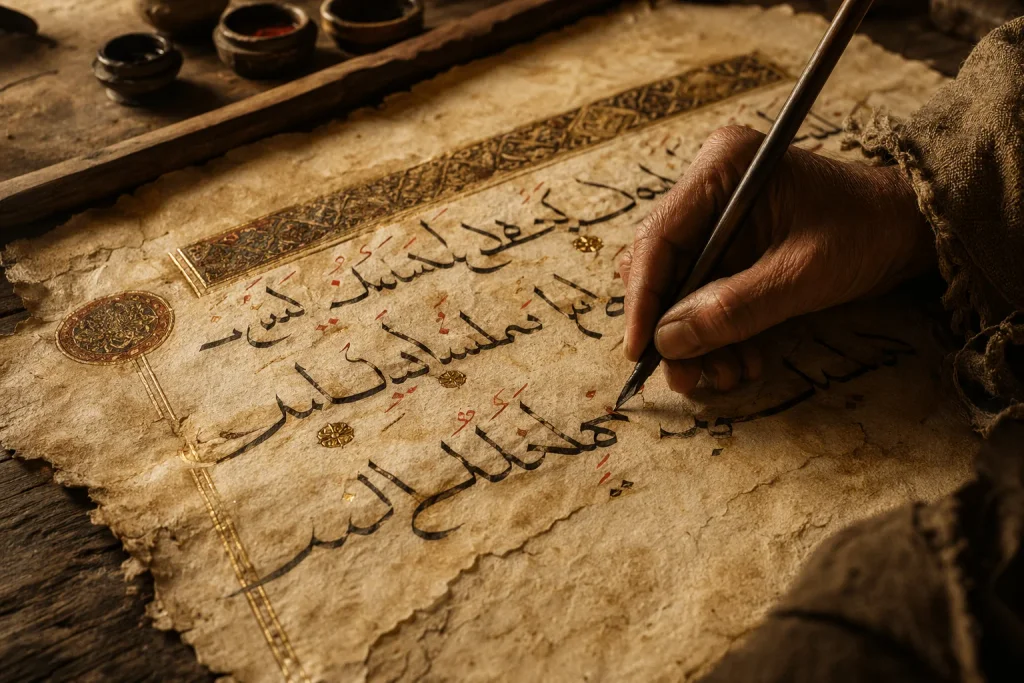
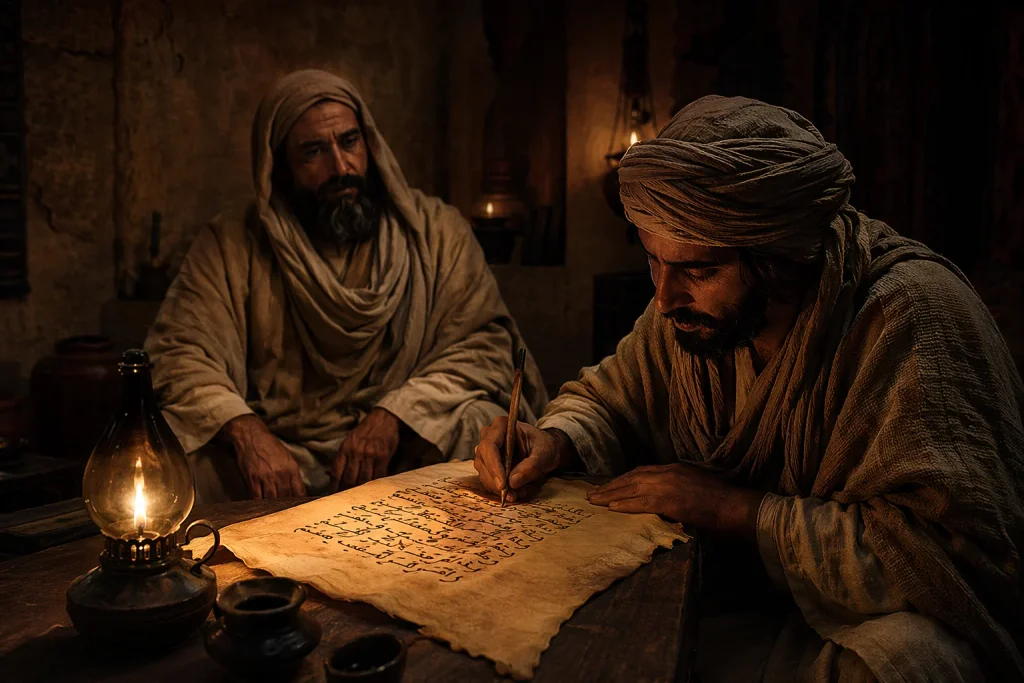
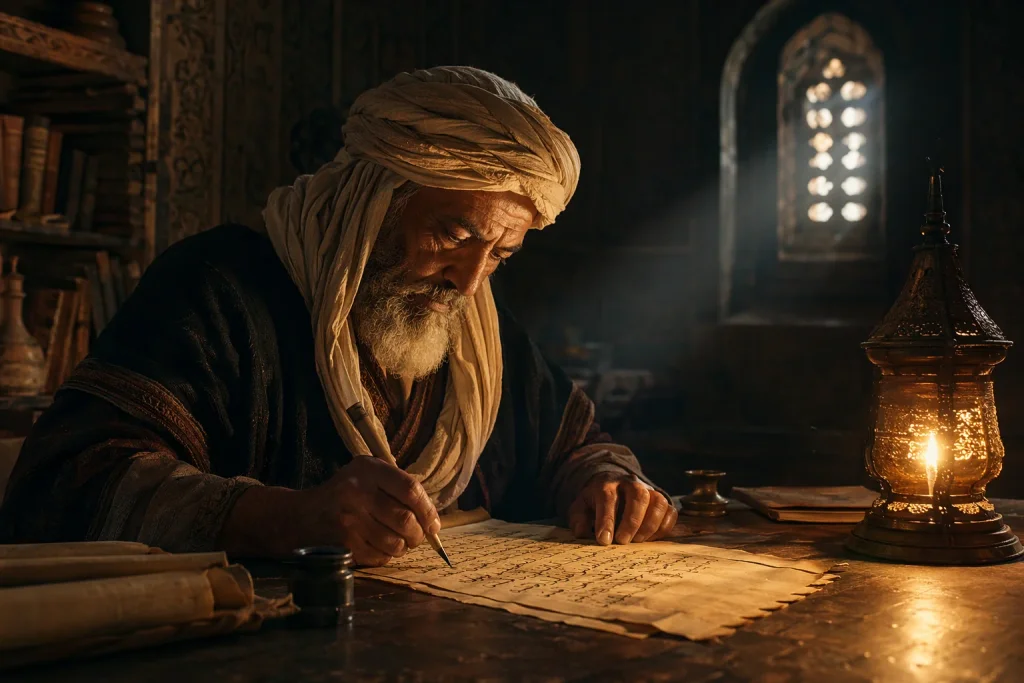
A scribe writing an ancient manuscript by lamplight
Evidence from Islamic Sources

Has the Quran Been
Perfectly Preserved?

The claim is absolute: not a single letter has changed since Muhammad. But a goat, a bonfire, a deathbed pen, and the laws of probability all tell a different story — and every witness cited here is an authenticated Islamic source.

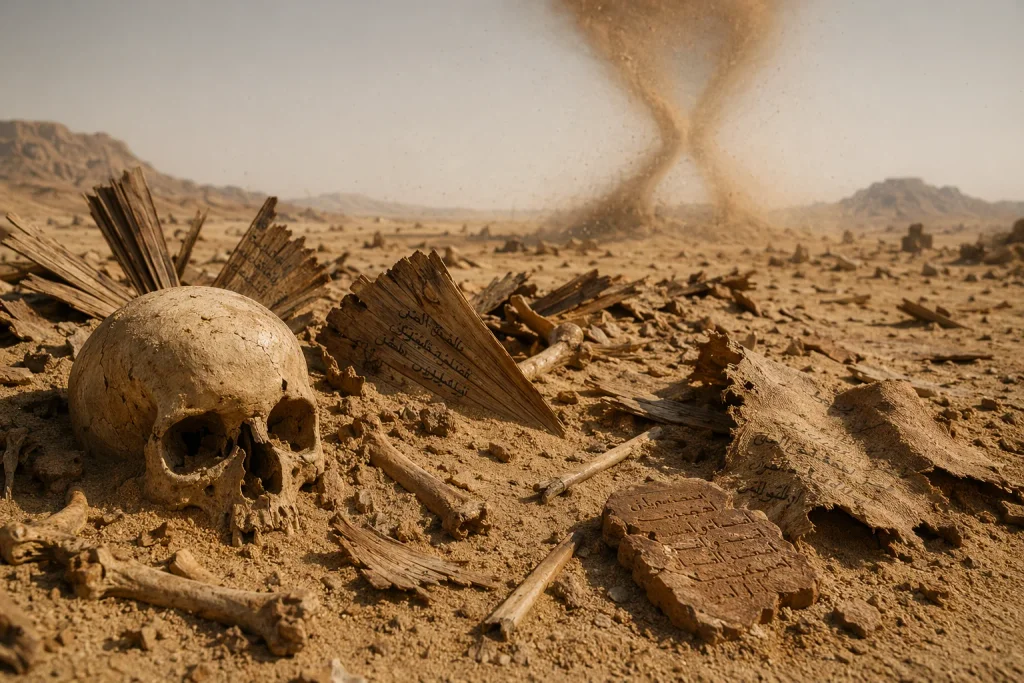
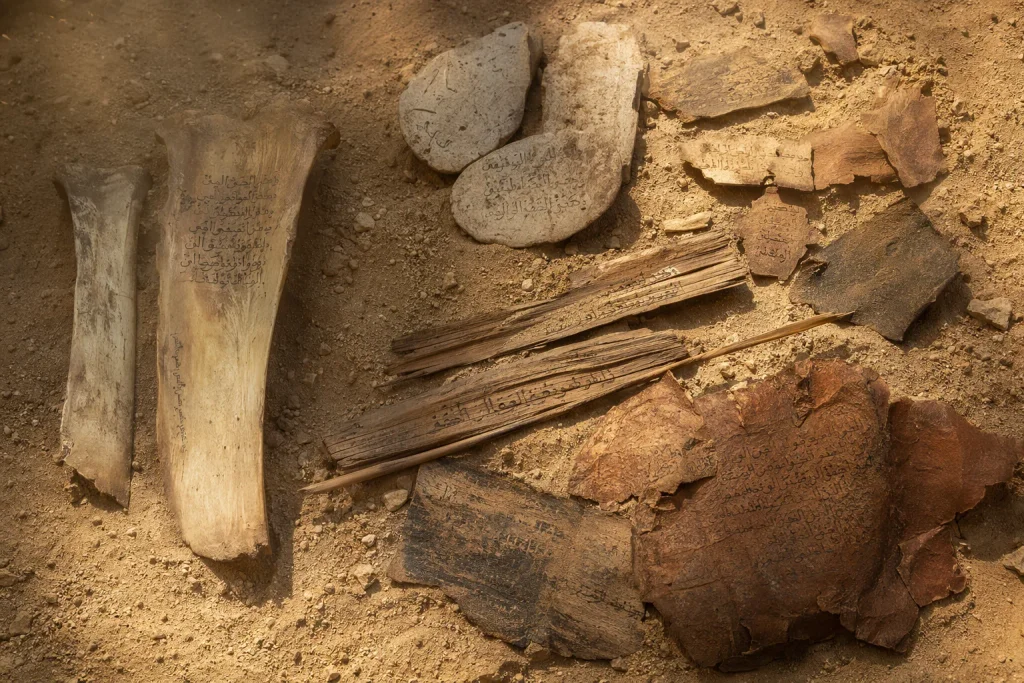
Ancient writing materials: bones, palm leaves, leather and stones with Quranic text
The Physical Reality

Written on Bones and Leaves

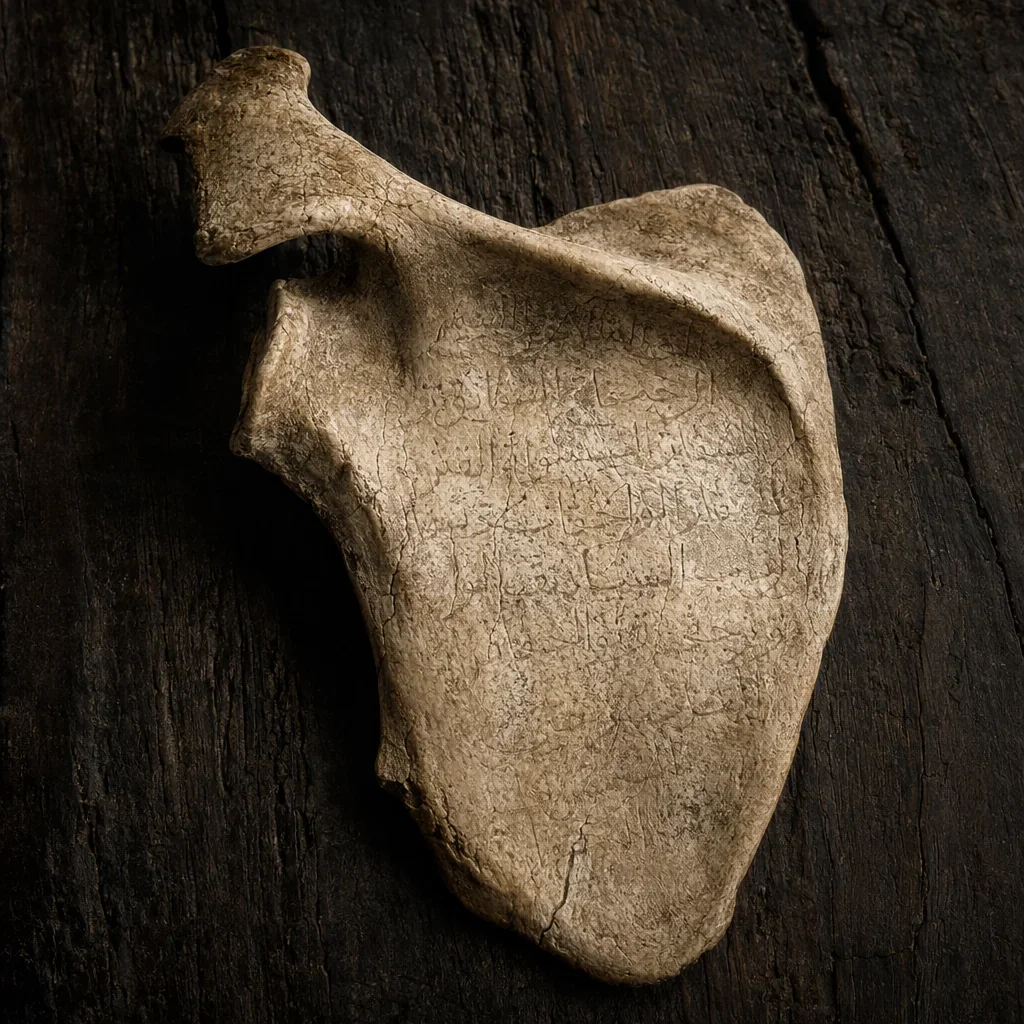
Before there was a book, there were bones, palm leaves, flat stones and leather scraps. This is what 'perfectly preserved' looked like for the first 20 years.

Shoulder Blades

Shoulder Blades

Flat bones from camels, scraped clean and inked

⏱ Decay rate

Exposed bone degrades within 5–15 years in arid heat; ink fades faster

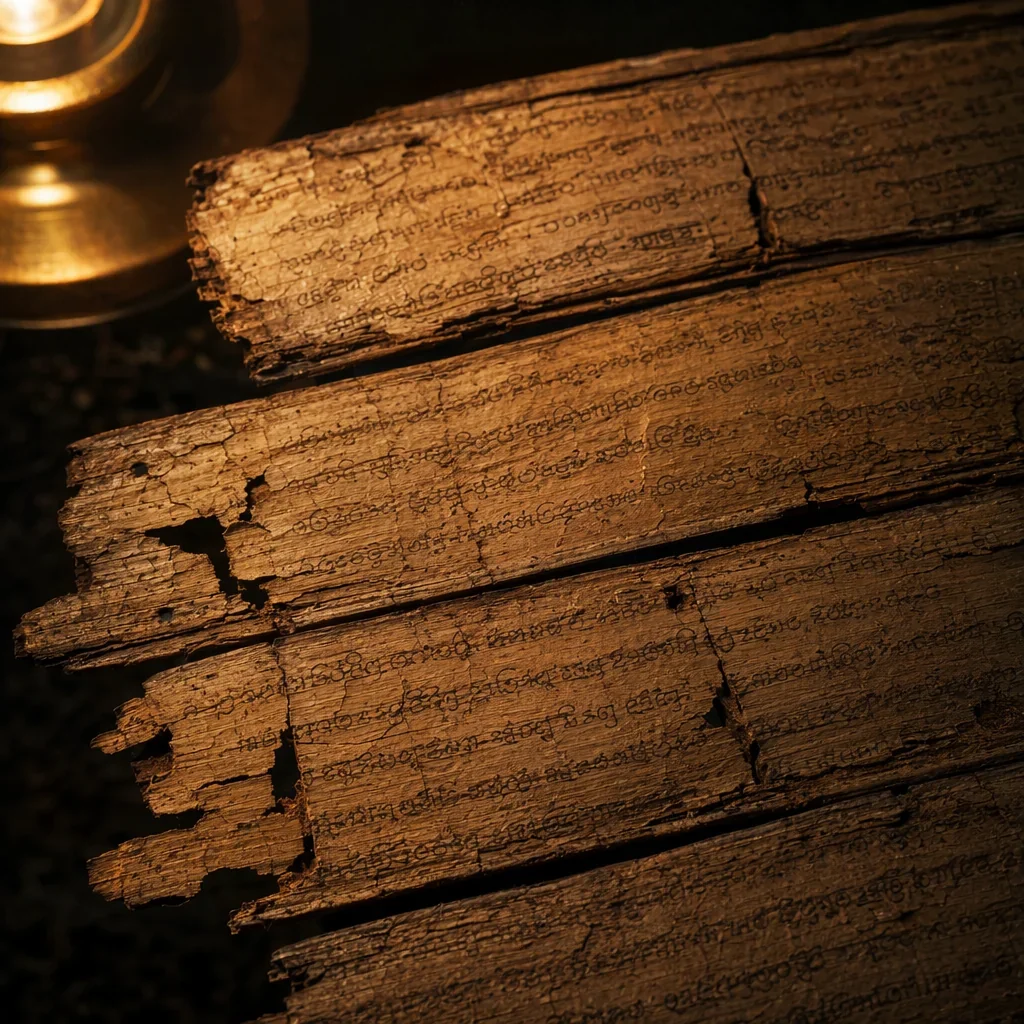
Palm Leaf Stalks

Palm Leaf Stalks

Dried ribs of date palm fronds — thin, brittle, perishable

⏱ Decay rate

Palm leaves crack and disintegrate within 2–5 years without careful storage

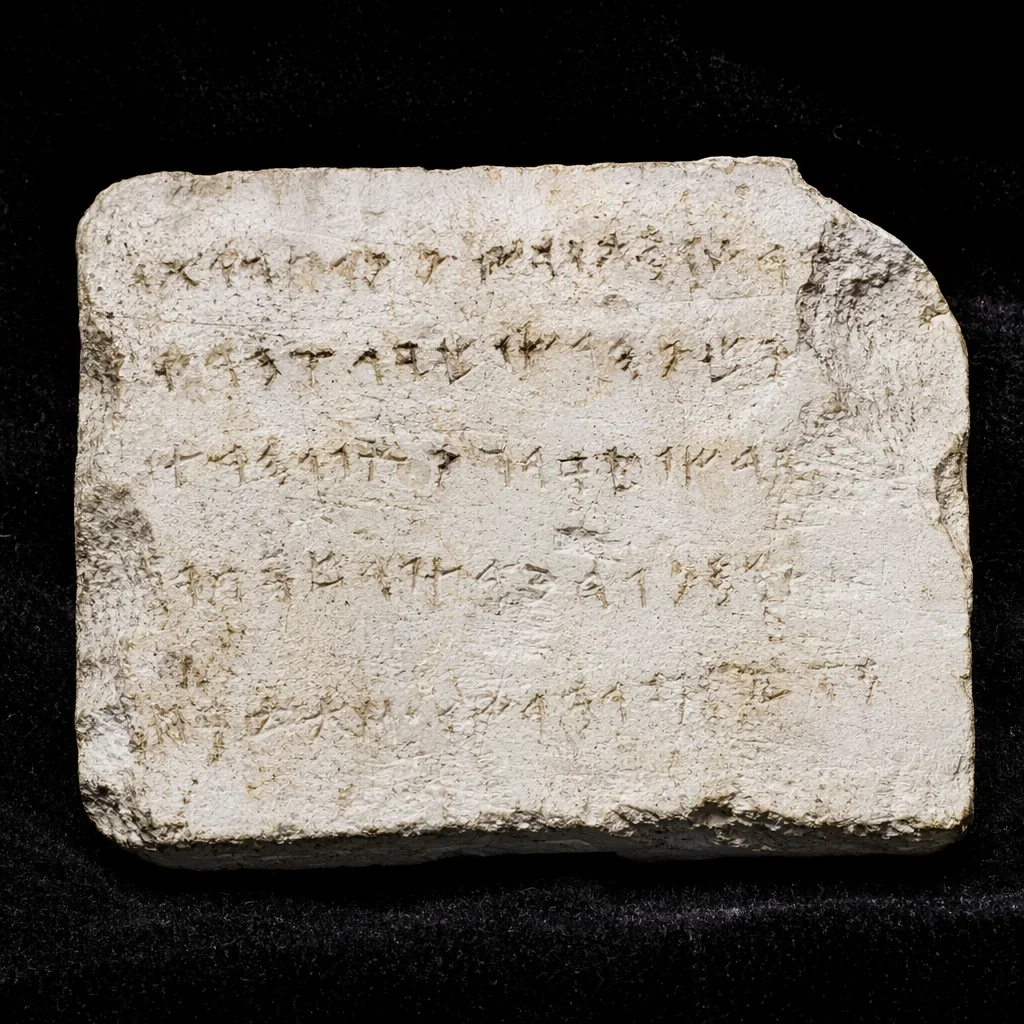
Flat Stones

Flat Stones

Thin white stones (likhaf) used as writing tablets

⏱ Decay rate

Stone endures, but ink washes off in rain or abrades within a few decades

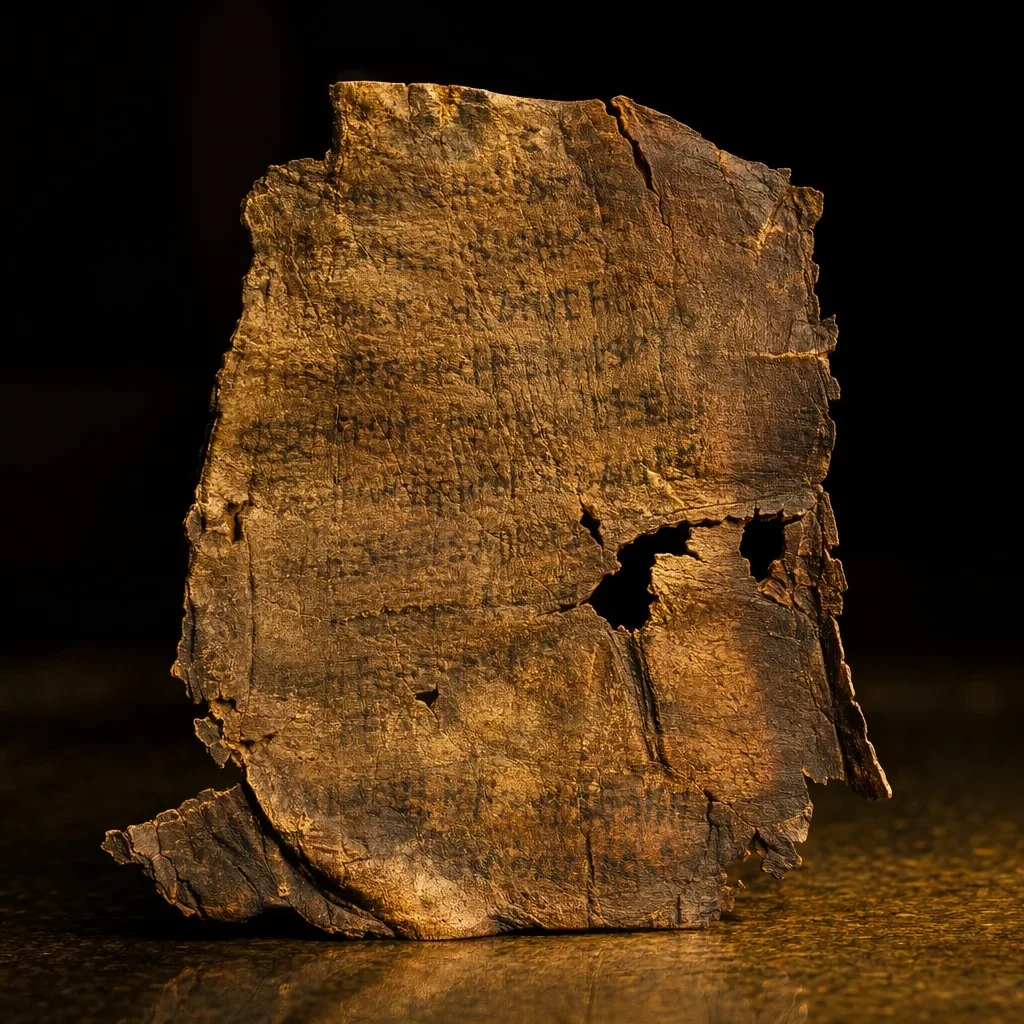
Leather Scraps

Leather Scraps

Pieces of animal skin, often small and irregular

⏱ Decay rate

Untreated leather rots in 10–20 years; desert heat accelerates cracking

No Book Existed

For the entire twenty-three years of Muhammad's ministry, the Quran was never compiled into a single document. Verses were scattered across these fragile, perishable materials — kept by different scribes in different locations with no coordination between them.

Some materials were stored under beds. Some were kept by individual companions who could not cross-reference one another. There was no master copy, no central archive, and no verification system.

“I used to write down the revelation for the Messenger of Allah on shoulder-blades, thin white stones, and palm-leaf stalks.”

Zayd ibn Thabit · Reported in al-Hakim
Read the full analysis
Scattered ancient writing materials
The Procession of the Text

Twenty Years Without a Complete Book

The standard narrative implies the Quran was secured from the moment of revelation. But follow the timeline chapter by chapter: the text was not compiled into a single codex until nearly twenty years after Muhammad's death — and every rival copy was then consigned to the flames.

610Chapter I · 610–632 AD
A reed pen on parchment — the medium of the first revelations
PicturedA reed pen on parchment — the medium of the first revelations

Revelation — Recited Over 23 Years

Muhammad receives revelations across twenty-three years. He cannot read or write. No complete written Quran exists at any point during his lifetime. Verses are memorised by companions and recorded by scribes — from oral dictation — on scattered bones, palm-leaves, and animal skins.

What this means

From the very first day, the text lived in fragile human memory and on perishable scraps — never in one verified, bound volume.

632Chapter II · 632 AD
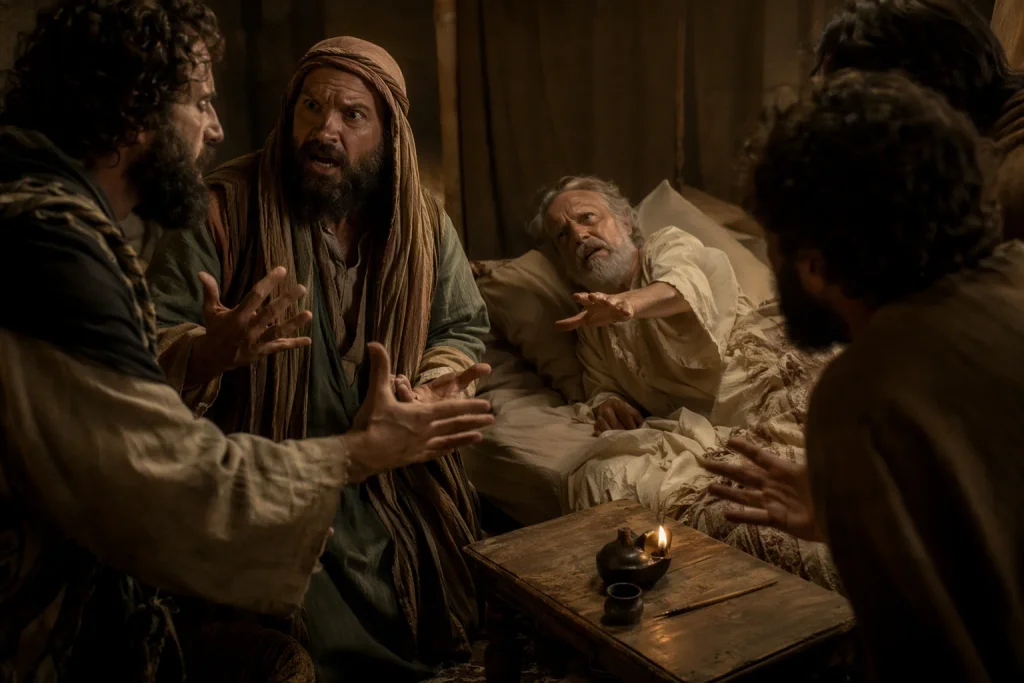
Companions arguing at the bedside while Muhammad reaches for pen and parchment
PicturedCompanions arguing at the bedside while Muhammad reaches for pen and parchment

Muhammad Dies — Still No Book

Muhammad dies in 632 AD. There is still no official, complete, bound codex of the Quran. On his deathbed he requests writing materials so the community 'will not go astray after me' — but the dispute that erupts among the companions means nothing is written down.

What this means

The one man who could authenticate a revelation is gone — and the Quran remains uncollected.

633Chapter III · 632–634 AD
The battlefield of Yamāma — scrolls scattered among the fallen memorisers
PicturedThe battlefield of Yamāma — scrolls scattered among the fallen memorisers

Memorisers Killed — The First Collection

Scores of ḥuffāẓ (memorisers) are killed in the Riddah Wars, particularly at the Battle of Yamāma. Fearing irreversible loss, Abū Bakr reluctantly orders Zayd ibn Thābit to hunt down every fragment — from palm-leaves, flat stones, shoulder-blades, and the 'breasts of men.'

What this means

The panic to collect proves the obvious: living memory was already failing, and written material was scattered and at risk of permanent loss.

640Chapter IV · 634–650 AD
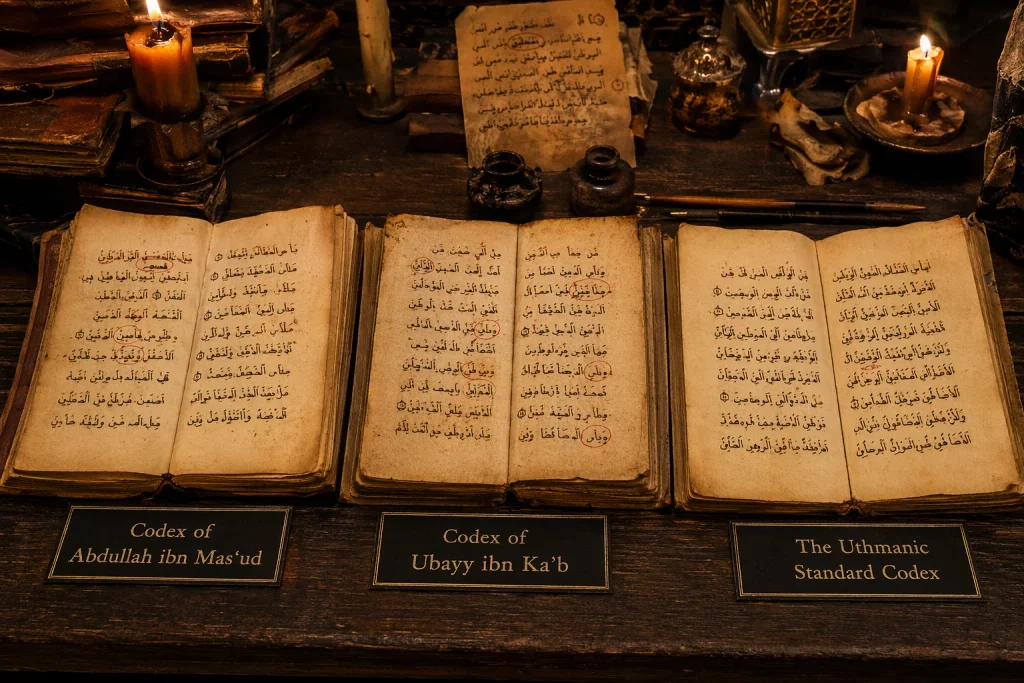
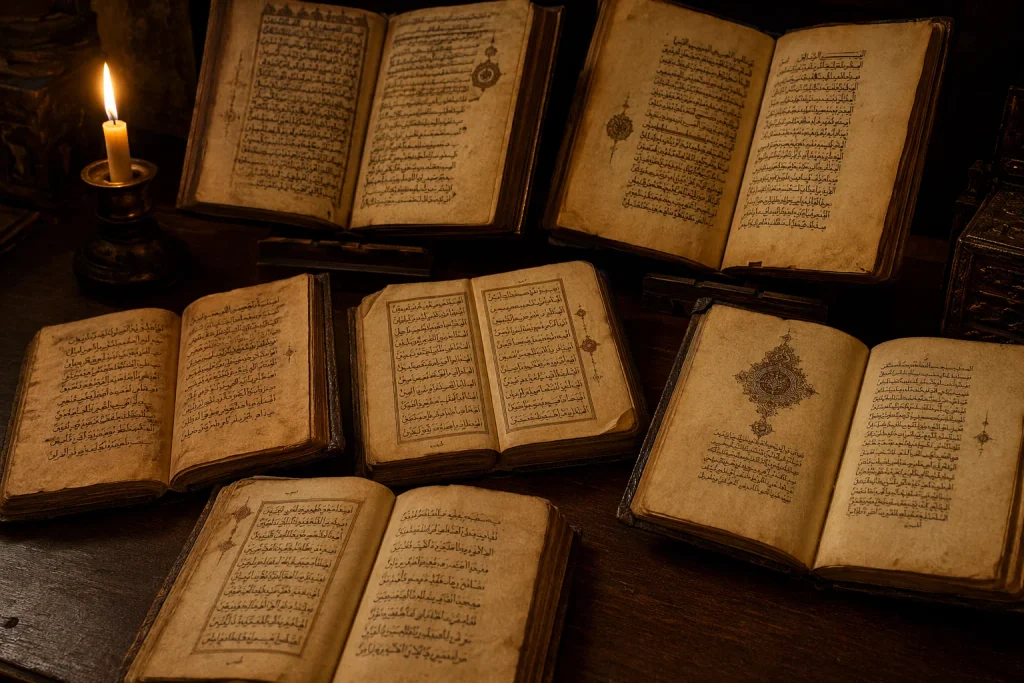
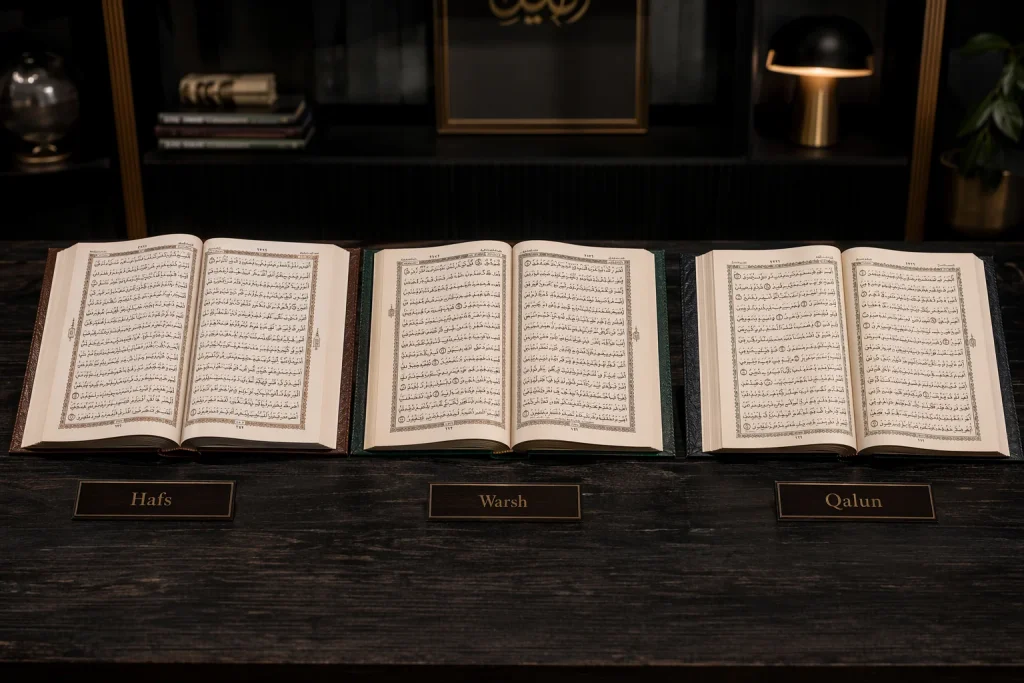
Three codices laid open — each showing different text by candlelight
PicturedThree codices laid open — each showing different text by candlelight

One Private Sheaf — and Competing Codices

Abū Bakr's collected sheets pass to 'Umar, then to his daughter Ḥafṣa. For years the closest thing to an official text is a single private bundle with no public access — while leading reciters like Ibn Mas'ūd and Ubayy ibn Ka'b maintain their own codices, which differ in content, chapter count, and arrangement.

What this means

The 'preserved' text spent years as a single private sheaf, while rival versions circulated freely across the provinces.

650Chapter V · ~650 AD
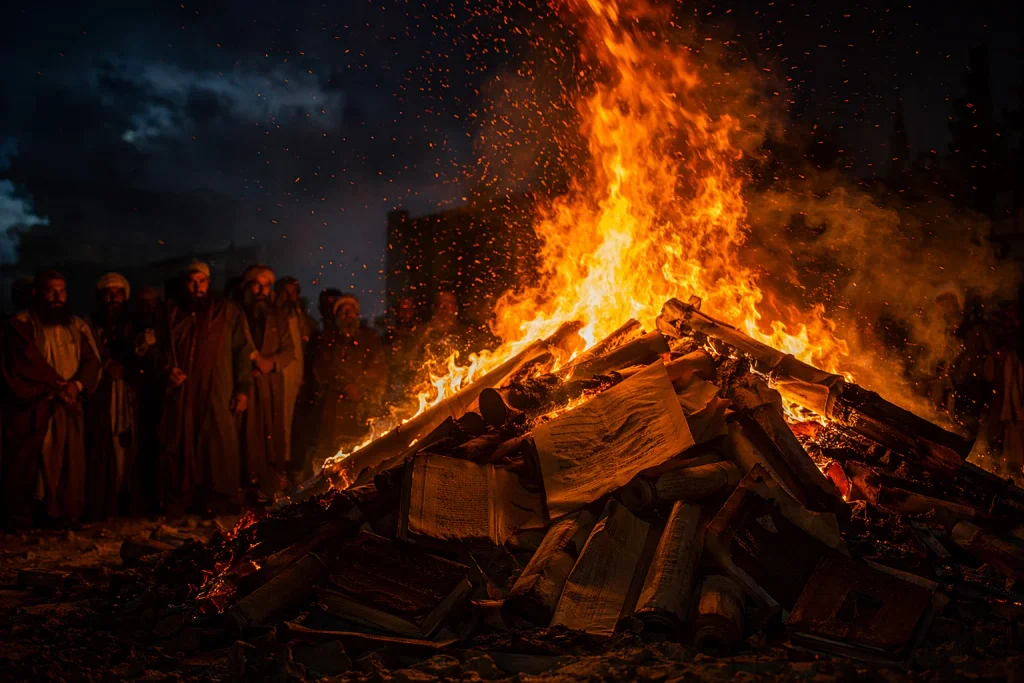
Flame — the fate 'Uthmān decreed for every rival copy
PicturedFlame — the fate 'Uthmān decreed for every rival copy

'Uthmān Standardises — and Burns the Rest

Approximately 18–20 years after Muhammad's death, Caliph 'Uthmān convenes a committee, standardises one version in the Quraysh dialect, dispatches copies to the major provinces, and orders every other codex — including those of senior companions — to be burned.

What this means

If every copy were already identical, there would be nothing to burn. The bonfire is itself the confession.

700Chapter VI · ~690–710 AD
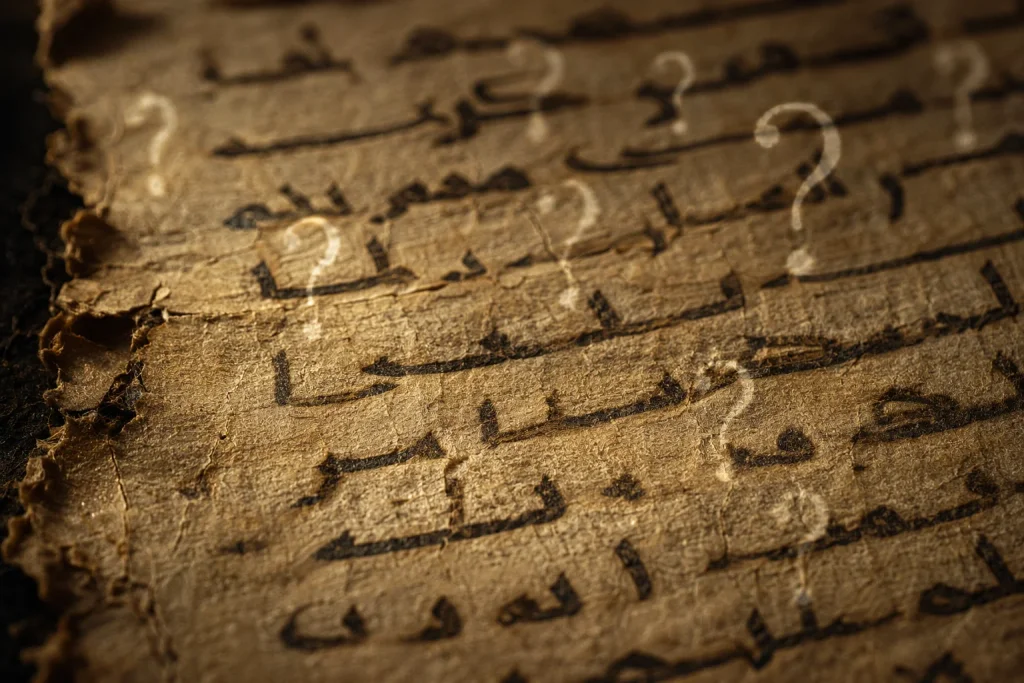
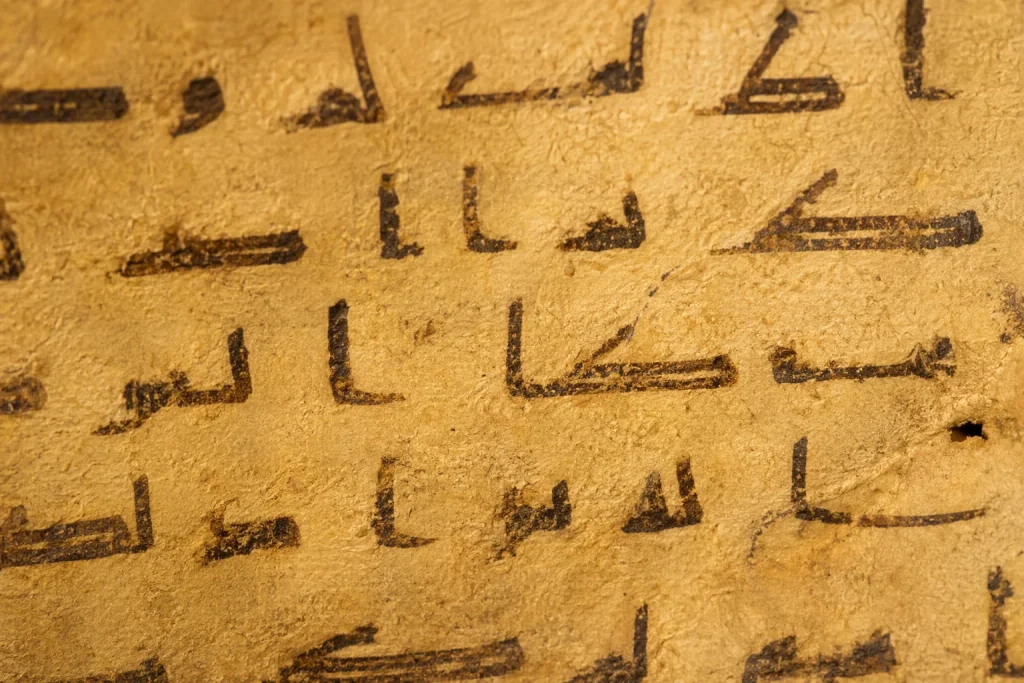
An undotted rasm — fifteen letters sharing the same skeleton
PicturedAn undotted rasm — fifteen letters sharing the same skeleton

The Dotting Crisis — Letters Without Identity

Early Arabic script had no dots. Fifteen of the twenty-eight letters shared identical shapes — distinguished only by context or the reader's memory. Governor al-Ḥajjāj ibn Yūsuf commissions diacritical dots to be added to the Quranic text decades after 'Uthmān's copies were dispatched. Until then, the same skeleton could be read as entirely different words.

What this means

For decades the 'preserved' text was literally ambiguous — the same written shape could yield different words, and humans chose which reading to fix in place.

750Chapter VII · ~750–800 AD
A scholar adding vowel marks to bare consonantal text
PicturedA scholar adding vowel marks to bare consonantal text

Vowel Marks Added — Pronunciation Imposed

The original Quranic manuscripts contained only consonants — no short vowels, no markers for doubling or elongation. Over the following century, scholars such as Abū al-Aswad al-Du'alī and al-Khalīl ibn Aḥmad develop and impose a system of vowel marks (tashkīl). These marks determine how every word is pronounced and, in many cases, what it means.

What this means

Pronunciation was not 'preserved' — it was reconstructed by later scholars making interpretive choices about a bare skeleton of consonants.

936Chapter VIII · ~900–950 AD
Multiple reading traditions laid side by side
PicturedMultiple reading traditions laid side by side

Ibn Mujāhid Canonises Seven Readings

By the tenth century, so many variant readings circulate that scholar Ibn Mujāhid intervenes to canonise exactly seven as 'authentic' (later expanded to ten, then fourteen). Each reading has its own chain of transmission and differs from the others in vowelling, consonants, and occasionally entire words. The very act of canonisation is an admission that one single reading never existed.

What this means

Canonising multiple readings is the opposite of 'one perfect text.' It is an institutional acknowledgement that the Quran has always existed in variant forms.

1924Chapter IX · 1924 AD
The 1924 Cairo edition — one reading chosen for the printing press
PicturedThe 1924 Cairo edition — one reading chosen for the printing press

The Cairo Edition — One Version for the Modern World

In 1924, Egypt's King Fu'ād commissions a committee to produce a single printed Quran. They choose the Ḥafṣ reading (transmitted through Kūfa) and publish it as the 'standard.' This edition — not a manuscript from Muhammad's time — becomes the text most Muslims worldwide recognise today. It is barely a century old.

What this means

The 'unchanged since revelation' text that most Muslims hold was actually standardised by a twentieth-century committee choosing one reading from many.

2026Chapter X · Today
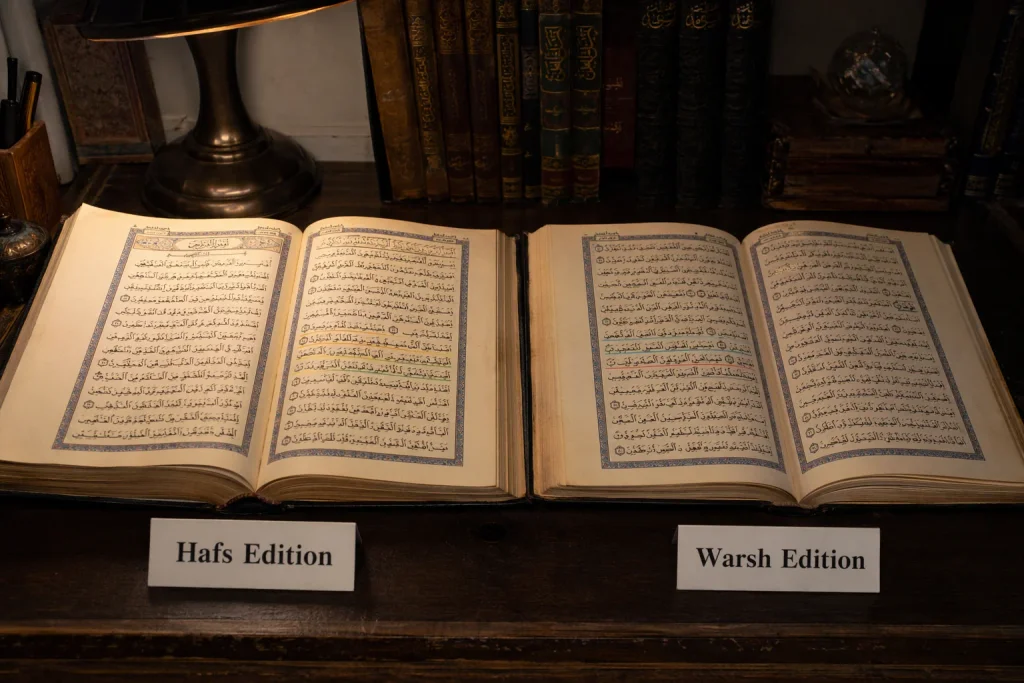
Ḥafṣ and Warsh editions — two 'perfect' Qurans that differ
PicturedḤafṣ and Warsh editions — two 'perfect' Qurans that differ

Today — Multiple Versions Still in Use

Right now, multiple canonical Qurans are in print. The Ḥafṣ reading dominates (~95% of the Muslim world), but the Warsh reading is standard across North and West Africa, and the Qālūn reading is used in parts of Libya and Tunisia. These are not merely pronunciation differences — they include variant consonants, different words, and altered meanings. There is no single 'the Quran' — there are Qurans.

What this means

The claim of 'one unchanged book' collapses under the weight of the multiple editions sitting on shelves today — each called 'the Quran,' each differing from the others.

The Exhibits

What the Sources Actually Say

Every claim below is sourced directly to Islam's own canonical hadith collections and earliest historical records. No external polemic — only what the tradition itself admits.

The Illiterate Author
Exhibit 01

The Illiterate Author

The Quran describes Muhammad as al-nabī al-ummī — the unlettered prophet. He employed scribes to record revelation but could never personally verify what they wrote. Across 6,236 verses dictated over twenty-three years, the absence of authorial proof-reading is a structural vulnerability that no amount of trust can close.

Quran 7:157 · 29:48Full account
Forgotten Surahs & Rival Codices
Exhibit 02

Forgotten Surahs & Rival Codices

Abū Mūsā al-Ash'arī testified that his community once recited a surah comparable in length to Barā'ah (Surah 9) — yet it was entirely forgotten.Muslim 1050 Meanwhile, Ibn Mas'ūd's personal muṣḥaf omitted three chapters; Ubayy ibn Ka'b's included two additional ones. The most trusted reciters could not agree on what the Quran contained.

Muslim 1050 · Bukhari 4999Full account
Seven Modes, Multiple Wordings
Exhibit 03

Seven Modes, Multiple Wordings

Muhammad himself stated that the Quran was revealed in seven aḥruf.Bukhari 4992 Today, the two most widely printed editions — Ḥafṣ and Warsh — differ in hundreds of places, including consonantal text. A book that exists in multiple officially sanctioned wordings cannot simultaneously be "one text preserved letter-for-letter."

Sahih al-Bukhari 4992Full account
The Perfect-Memory Claim
Exhibit 04

The Perfect-Memory Claim

The fallback defence is that ḥuffāẓ (memorisers) guaranteed perfect transmission. Yet the Prophet himself was reminded of verses he had forgotten,Bukhari 5038 seventy reciters were killed at the Battle of Yamāma, and the resulting panic drove Abū Bakr to commission the first written collection — an act that concedes memory alone was insufficient.

Bukhari 5037–5038Full account
The Undotted Skeleton
Exhibit 05

The Undotted Skeleton

The earliest Quranic manuscripts were written in a bare consonantal skeleton (rasm) — no dots, no vowel marks. A single pen-stroke could represent b, t, th, n, or y. At Surah 1:4, the same skeleton yields "Master" (mālik) or "King" (malik) — and Ḥafṣ and Warsh read it differently to this day.

Quran 1:4 · 34:19Full account
Two Messages, One Text
Exhibit 06

Two Messages, One Text

To public audiences, the claim is absolute: no two Qurans differ by a single letter. To students of the Islamic sciences, the existence of variant readings is openly acknowledged and explained. When the popular message and the scholarly reality cannot be reconciled, the narrative has holes.

Quran 15:9 · Bukhari 4992Full account
The Strongest Witness

The Goat That Ate the Verses

Aisha's Testimony

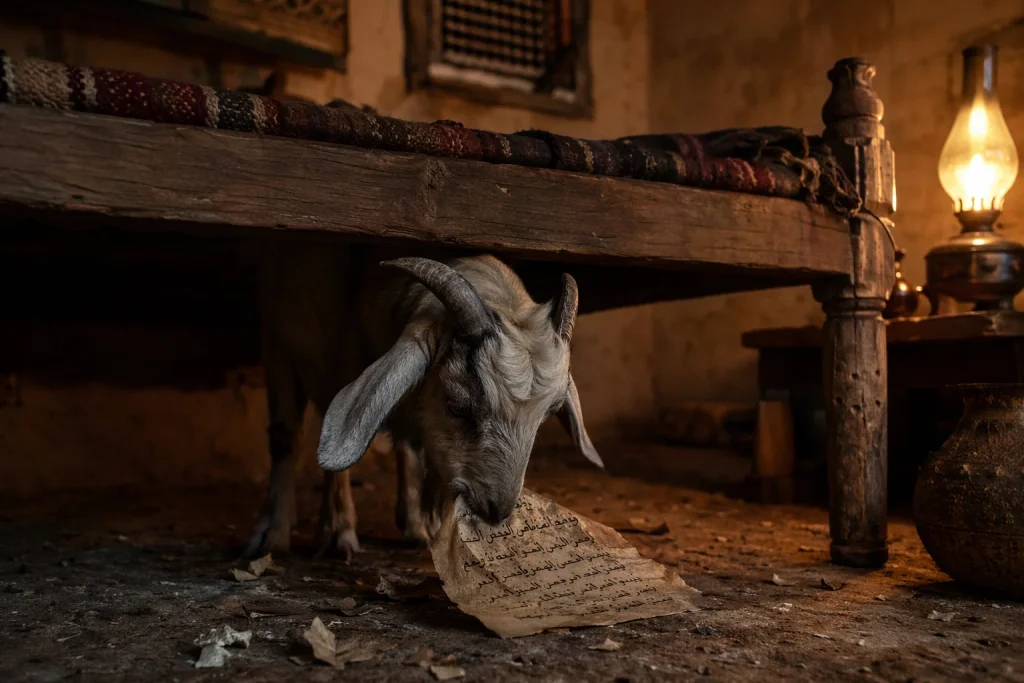
“The Verse of Stoning and of suckling an adult ten times were revealed... written on a paper which I placed under my bed. When the Messenger of Allah died, a goat came in and ate the paper.”

Sunan Ibn Majah 1944 · Sahih Muslim 1452a

These verses are not in today's Quran. A revealed text — physically written down — was destroyed and permanently lost. Sahih Muslim confirms these were genuine revealed verses — not just notes, but part of the Quran itself.

What do you call a holy book that is missing revealed verses eaten by a goat — and still call it perfectly preserved?

Read the full account
A goat eating a parchment of written verses
Variant Quran manuscripts being burned in a great fire
Destroyed Evidence

The Great Quran Burning

'Uthmān ordered that all other fragmentary manuscripts and variant codices be burned, to enforce a single uniform version across the expanding empire.

If every copy were already identical and perfectly preserved, there would be nothing to burn. The state-ordered destruction of rival codices is itself proof that meaningful textual differences existed — and were suppressed rather than reconciled. Ibn Mas'ūd himself refused to surrender his codex, insisting his version came directly from the Prophet's mouth.

Read the full account
Ancient palm leaf with Arabic text crumbling to dust in desert heat
The Fatal Gap

Death, Decay and Decades to Compile a Patchwork Text

The Quran was written on materials that rot, crack, and fade — then left uncompiled for years while the people who memorized it were dying in battle. Here is the timeline of what actually happened.

The Problem No One Addresses

Muhammad died in 632 CE. The first complete written compilation didn't happen until after the Battle of Yamama — when so many memorizers were killed that the surviving companions panicked. That means the Quran existed only on scattered, perishable scraps for at least two full years after Muhammad's death — and on those same scraps for the entire 23-year revelation period before that.

What happens to a bone left in Arabian desert heat for 2–25 years? It cracks. The ink fades. What happens to a palm leaf? It disintegrates. What happens to untreated leather? It rots. The very materials the Quran was written on were actively decaying during the entire period it was supposedly being "preserved."

And it wasn't just the elements. Aisha herself testifies that a goat came in and ate the parchment containing revealed verses — the verse of stoning and adult suckling. These verses are not in today's Quran. A domestic animal physically consumed part of the "perfectly preserved" revelation, and it was never recovered.

This isn't speculation — it's basic material science combined with eyewitness testimony from the Prophet's own wife. And the Islamic sources themselves confirm the panic: if the Quran were truly safe in people's memories, why did the death of memorizers at Yamama cause an emergency? Because everyone knew memory alone was not enough.
Timeline: From Revelation to Compilation

610–632 CERevelation period

23 years of verses written on perishable scraps — bones, palm leaves, leather, stones — stored in private homes with no central archive

632 CEMuhammad dies

No compiled book exists. Verses are scattered across dozens of companions' personal collections. No master copy was ever made during his lifetime.

632–634 CEBattle of Yamama

70+ memorizers killed in a single battle. Panic sets in. Abu Bakr orders emergency compilation — proving the text was NOT safely preserved.

634 CEZayd's compilation

One man tasked with collecting scraps from across the community. He searches for verses 'on palm-leaf stalks, thin white stones, and in the hearts of men.' Some verses found with only a single witness.

634–644 CEHafsa's private copy

The compiled sheets sit in one woman's house for ~12 years. No copies made. No independent verification. A single point of failure.

644–656 CEUthman's standardization

Disputes erupt over correct readings. Uthman forms a committee, selects ONE version, and orders every other copy in existence burned.

How It Was Actually Put Together

After Yamama, Zayd ibn Thabit — a single man — was tasked with collecting the entire Quran. His own description of the process reveals how precarious it was:

“I started searching for the Quran and collecting it from palm-leaf stalks, thin white stones, and the chests of men.”

Zayd ibn Thabit · Sahih al-Bukhari 4986

Notice what this means: there was no single source. Zayd had to go door-to-door, collecting fragments from different people's personal collections. Some verses were found with only one or two witnesses. The last two verses of Surah al-Tawbah were found with only one man — Abu Khuzaima al-Ansari.

“I found the last two verses of Surah at-Tawba with Abu Khuzaima al-Ansari and I did not find them with anyone else.”

Zayd ibn Thabit · Sahih al-Bukhari 4986

The Decay Mathematics

Consider the conditions:

  • Climate: The Hejaz region averages 40–50°C in summer. Extreme heat accelerates organic decay exponentially.
  • Palm leaves: Begin cracking within 1–2 years in dry heat. After 5 years, most are unreadable fragments.
  • Untreated leather: Rots within 10–20 years without tanning. Desert conditions cause cracking and flaking.
  • Bone: Surface ink fades within 5–10 years. The bone itself becomes brittle and chips.
  • Ink: Carbon-based inks of the era fade significantly within a decade on porous surfaces.

The revelation period lasted 23 years (610–632 CE). That means the earliest verses — written on palm leaves and bones — had been exposed to desert conditions for over two decades before anyone attempted to compile them. Many of these materials would have been physically destroyed by the time Zayd went looking for them.

This is why Zayd had to rely on "the chests of men" — because the physical evidence had already rotted away. And those men? Seventy of the best among them had just been killed at Yamama.

Why This Isn't Preservation

No Original Exists

Not a single scrap from Muhammad's time survives. Every 'original' has decayed to nothing.

Single Points of Failure

Some verses found with only one person. If he had died at Yamama, those verses would be lost forever.

No Cross-Verification

Zayd collected fragments from individuals — there was no independent copy to check against.

Memory After Trauma

Survivors of a battle where 70 friends died were asked to recall verses perfectly. Trauma degrades memory.

Political Compilation

Uthman's committee made editorial choices — selecting one reading over others, then burning the alternatives.

Destroyed Evidence

By burning every rival copy, Uthman ensured no one could ever verify whether his version matched the originals.

What we call "the Quran" today is not a preserved original — it is a reconstruction from decayed fragments and fallible human memory, edited by a political committee, with all alternative evidence deliberately destroyed.

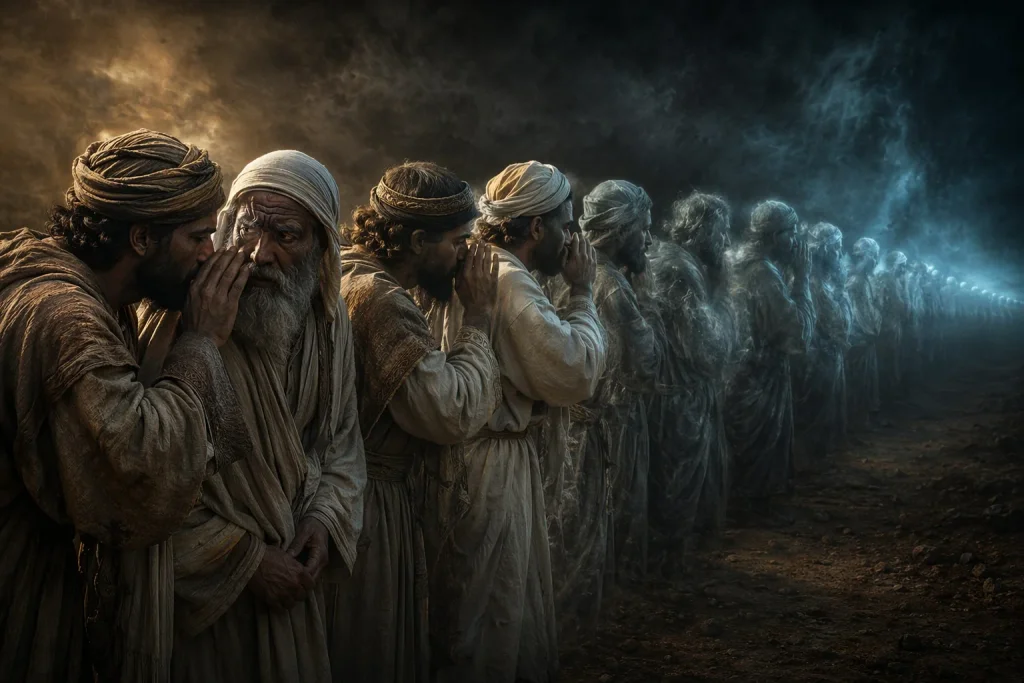
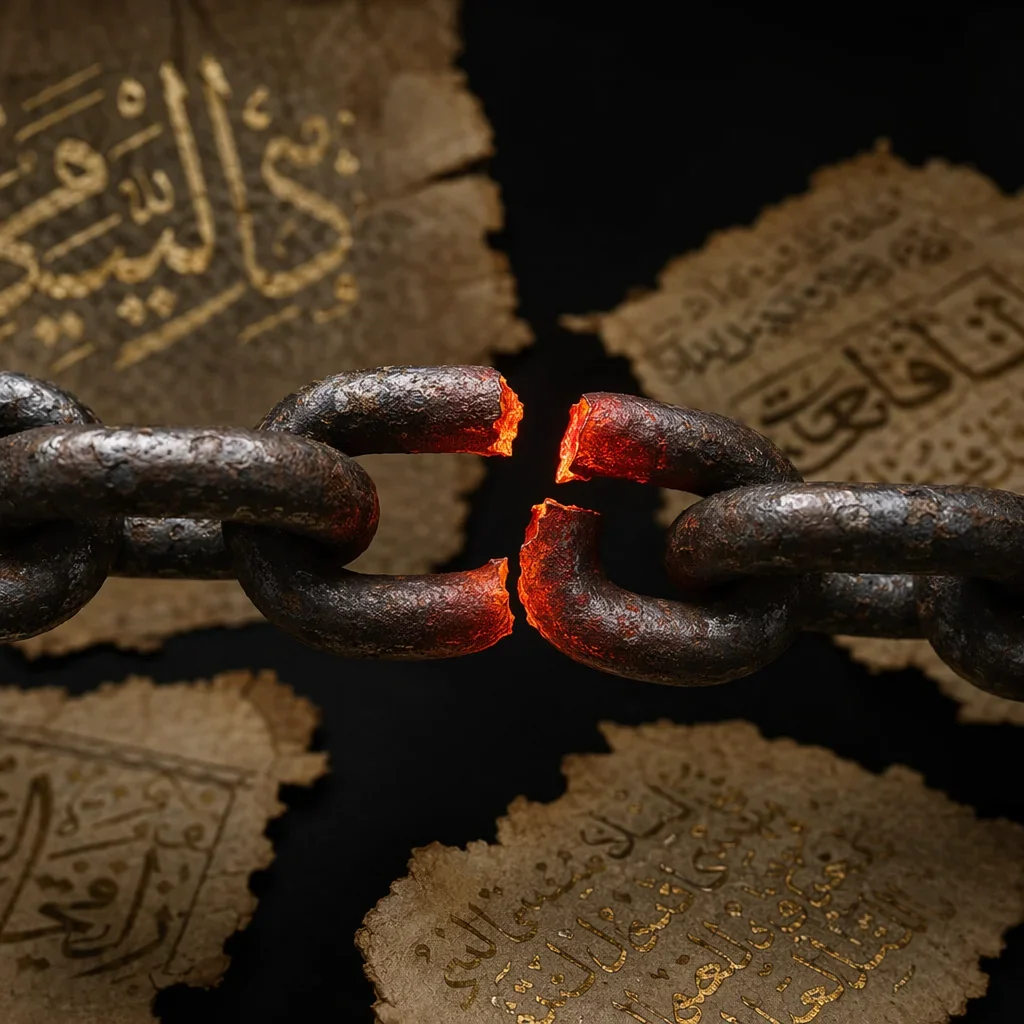
A fragile chain of people passing words, with broken links
The Broken Links

The Broken Chain: Whispers Passed over 20 Years

Every legal document requires an unbroken chain of custody to be admissible. Follow the Quran's chain link by link — and watch them snap.

A fragile chain of people passing words like Chinese Whispers, with broken links showing information loss

Like a game of Chinese Whispers across centuries — each link introduces the possibility of loss, change, and error.

1

Muhammad recites

Illiterate — cannot read or write; unable to verify what scribes record

Scribes write on scraps

Multiple scribes working independently; no master copy; scattered across perishable materials

Memorizers carry the text

Seventy reciters killed at the Battle of Yamama; companions admit forgetting verses

Hafsa's private sheaf

A single copy in one woman's possession for years — no independent verification

5

Uthman's editorial committee

Human editorial choices imposed; one dialect selected, all others suppressed

All rival copies burned

Every alternative manuscript permanently destroyed — eliminating all evidence of variation

7

Today's Quran

The product of this chain — not a direct, verified link to Muhammad's mouth

A chain is only as strong as its weakest link. This chain has multiple broken links - yet we are told the product is flawless.

Physical Proof

The Sana'a Palimpsest

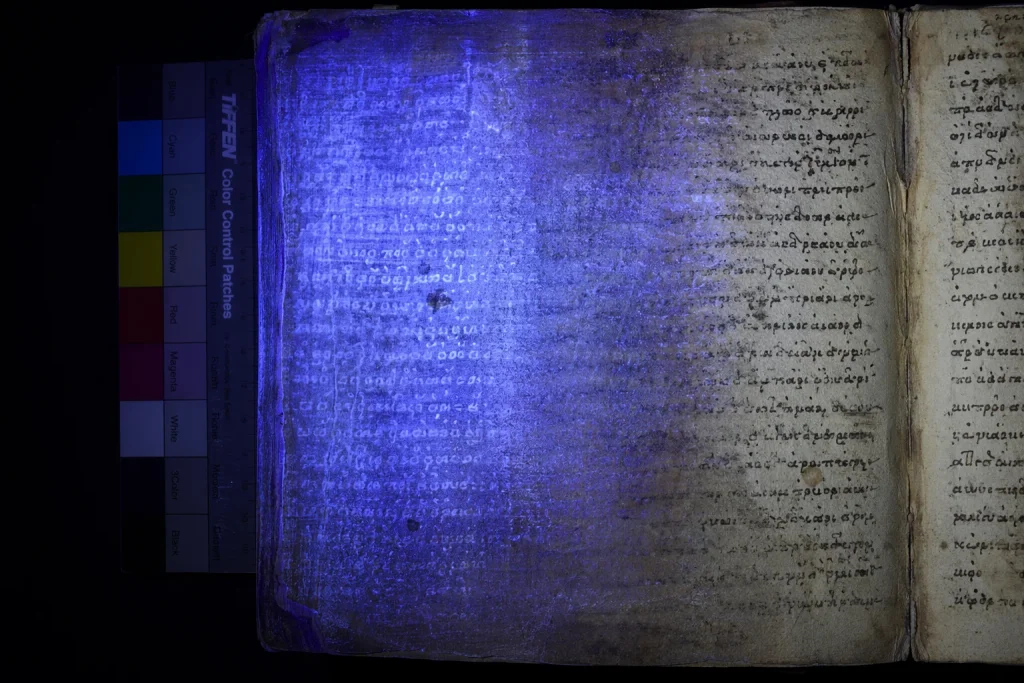
Beneath the ink of today's Quran lies a different text scraped away and overwritten physical proof the text was changed.

The erased lower text of the Sana'a palimpsestThe upper text of the Sana'a palimpsestUpperLower
Drag to peel today's text off the erased original

The Ṣan'ā' manuscript (DAM 01-27.1) is the oldest substantial Quran yet discovered — a palimpsest. Its erased lower text, recovered through ultraviolet and multispectral imaging, reveals different word order, omissions, and textual variants from the standard 'Uthmānic text.

This is not speculation. It is physical, laboratory-confirmed evidence of textual development: an earlier version of the Quran was deliberately scrubbed away and overwritten with a later one.

A washed-out lower layer + an overwritten upper layer = a literal, physical record of the text being changed.

Read the full account
Two Qurans In Print Today

Which Quran Are You Reading?

Two Qurans printed and recited right now differ in hundreds of places. Here are three.

Two printed Qurans open side by side showing different text

Two official Qurans — same religion, different words. Both in print and recited today.

Surah 3:146
Ḥafṣ ʿan ʿĀṣim
Most of the Muslim world
قَاتَلَ
qātala
fought alongside him
Warsh ʿan Nāfiʿ
North & West Africa
قُتِلَ
qutila
was killed
What changes

“The prophet fought” versus “the prophet was killed” — opposite events.

Surah 2:184
Ḥafṣ ʿan ʿĀṣim
Most of the Muslim world
طَعَامُ مِسْكِينٍ
ṭaʿāmu miskīn
feeding of one poor person
Warsh ʿan Nāfiʿ
North & West Africa
طَعَامُ مَسَاكِينَ
ṭaʿāmu masākīn
feeding of poor people
What changes

Singular versus plural — a different ruling on who must be fed.

Surah 2:259
Ḥafṣ ʿan ʿĀṣim
Most of the Muslim world
نُنشِزُهَا
nunshizuhā
how We raise them up
Warsh ʿan Nāfiʿ
North & West Africa
نَنشُرُهَا
nanshuruhā
how We spread them out
What changes

One dotted letter rewrites the verb describing the miracle itself.

Before the Dots

Same Letters, Different Words

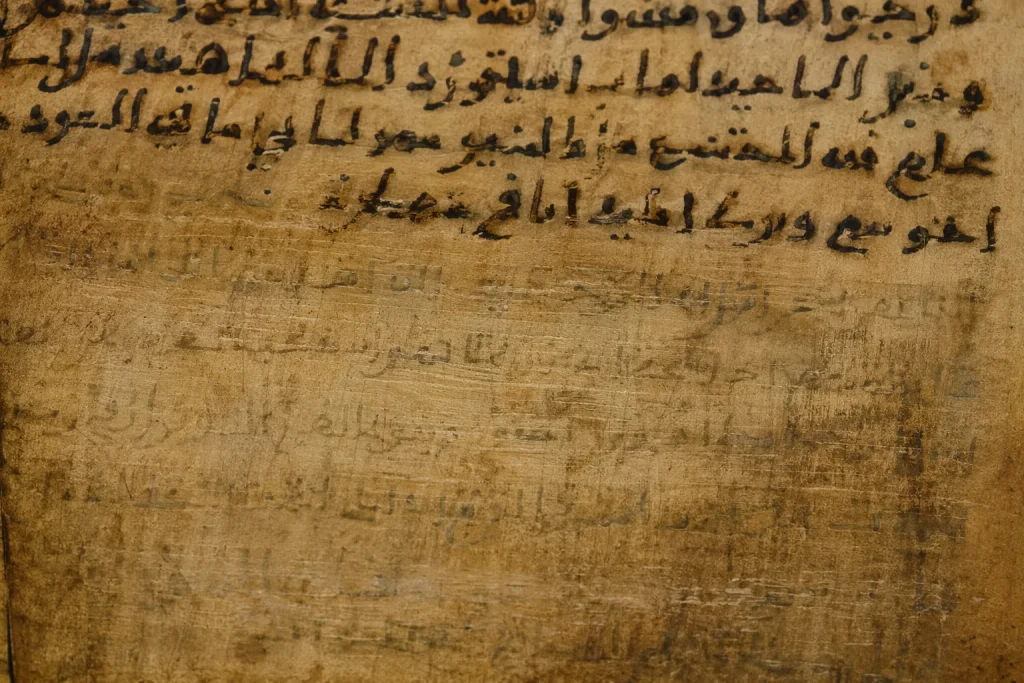
The earliest Qurans were written without dots or vowel marks — only the bare consonantal skeleton (rasm). The same skeleton can be read as entirely different words.

One stroke, five letters
ٮ
undotted
بتثني

The same tooth-shaped stroke is b, t, th, n or y - decided only by dots that early manuscripts did not carry.

Close-up of undotted Arabic manuscript with ambiguous letters
The Double Standard

Two Messages, One Text

The same tradition that tells the public 'not a single letter differs' quietly teaches students that variant readings exist in both wording and meaning.

Two contradictory messages from the same tradition
The public message
“From the time of 'Uthmān to the present day, you will not find a single letter's difference between any two Qurans in the world.”

— Repeated in Friday sermons, apologetics videos, and da'wah pamphlets worldwide.

The scholarly reality
“If you travel to different parts of the Muslim world, you encounter different Qurans. There are differences — in words, in letters, and sometimes in meaning.”

— Acknowledged in 'ulūm al-Qur'ān courses, qirā'āt institutes, and academic ḥadīth studies.

Both statements cannot be true simultaneously. Either the Quran has been preserved letter-for-letter, or variant readings exist. The tradition itself provides both answers — depending on the audience. This is the hole in the narrative.

The Tally

The Verses That Were Lost Forever

Every figure below is drawn from the Islamic sources themselves.

0
Verses consumed by a goat

The stoning and adult-suckling verses — written on parchment, then physically destroyed.

0+
Entire surahs forgotten

Companions testified to reciting whole chapters that no longer exist in any muṣḥaf.

0
Chapters rejected by Ibn Mas'ūd

He refused to include al-Fātiḥah, al-Falaq, and al-Nās in his personal codex.

~0%
Of rival codices burned

Every competing manuscript ordered destroyed by 'Uthmān's state decree.

0 yrs
Gap to a standardised text

From Muhammad's death to 'Uthmān's official edition — nearly two decades of uncontrolled transmission.

0+
Variant differences still in print

Between the Ḥafṣ and Warsh editions recited across the Muslim world today.

The White Paper Analogy

The White Page Test — How Memory Rewrites History

Someone dictates a passage to you today. You write it from memory years later. Watch what happens — not only to the words, but to what they mean.

Stage 1
Dictated today

Give to the traveller and the orphan their rightful due, speak to people with kindness, and stand firm in the measure, by morning and by evening.

The words, spoken aloud — clear, complete, exact.

Stage 2
Years pass, recalled

Give to the traveller and the orphan their rightful fair due, share, speak to people with kindness, and stand firm in the measure, by morning and by evening.

Memory softens. “Rightful due” is already slipping toward “fair share.”

Stage 3
Rewritten from memory

Give to the traveller stranger and the orphan needy their rightful due, what you can spare, speak to people everyone with kindness, kindly, and stand firm in the measure, be fair, by morning and by evening. in due time.

It still reads smoothly — but a duty owed has quietly become charity offered.

Preserved Uncertain in memory Altered Lost
What it meant

A binding duty - give the traveller and the orphan the exact due they are owed, and be just in the measure.

What it became

A vague suggestion - give a stranger whatever you can spare, and be generally fair.

Every line still reads smoothly — that is precisely the danger. Nothing looks broken, yet a binding obligation has quietly become optional charity.

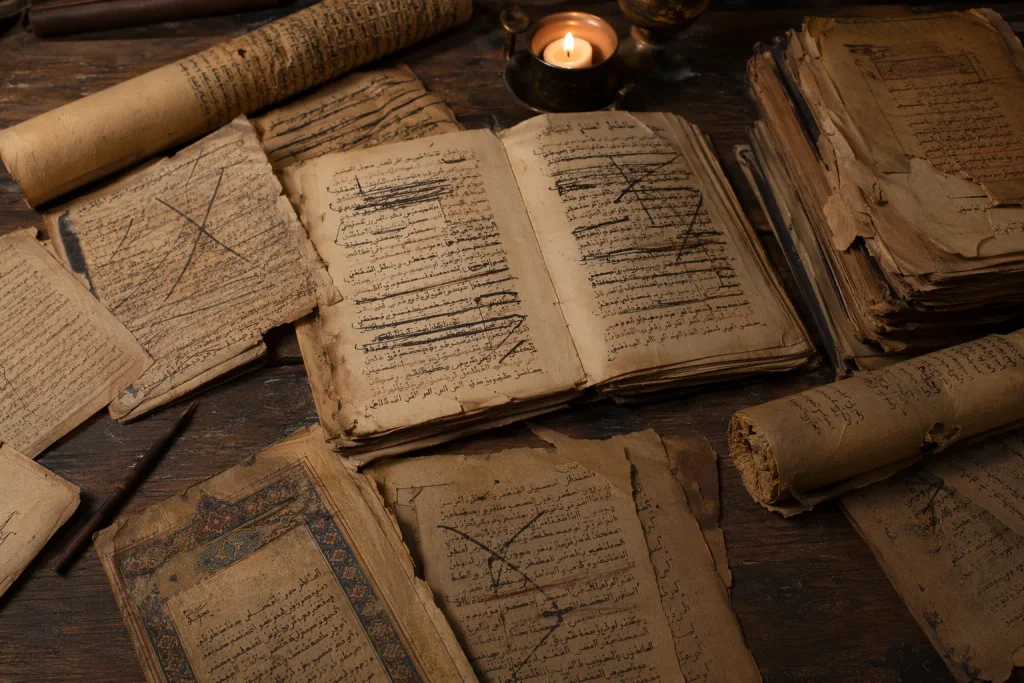
Ancient scholars examining parchment manuscripts by lamplight

That was one short sentence over a few years. The Quran was transmitted across 6,236 verses, by dozens of hands, over more than two decades.

The question is not whether memory is impressive. The question is whether it is perfect enough to stake divine authorship upon. Try it yourself below.

The Critical Point

He could not verify
a single page.

Muhammad could not read or write. Every verse of the Quran was dictated to scribes — and he had no way to check what they wrote down.

Not once in twenty-three years could he open a page and confirm it matched what he had spoken. He was entirely dependent on the accuracy of others — with zero ability to proof-read, correct, or authenticate the written record.

This is not a minor footnote. This is the foundation of the entire preservation claim — and it is built on blind trust, not verification.

“Imagine signing a contract you cannot read — for eternity. That is what ‘perfect preservation’ asks you to accept.”

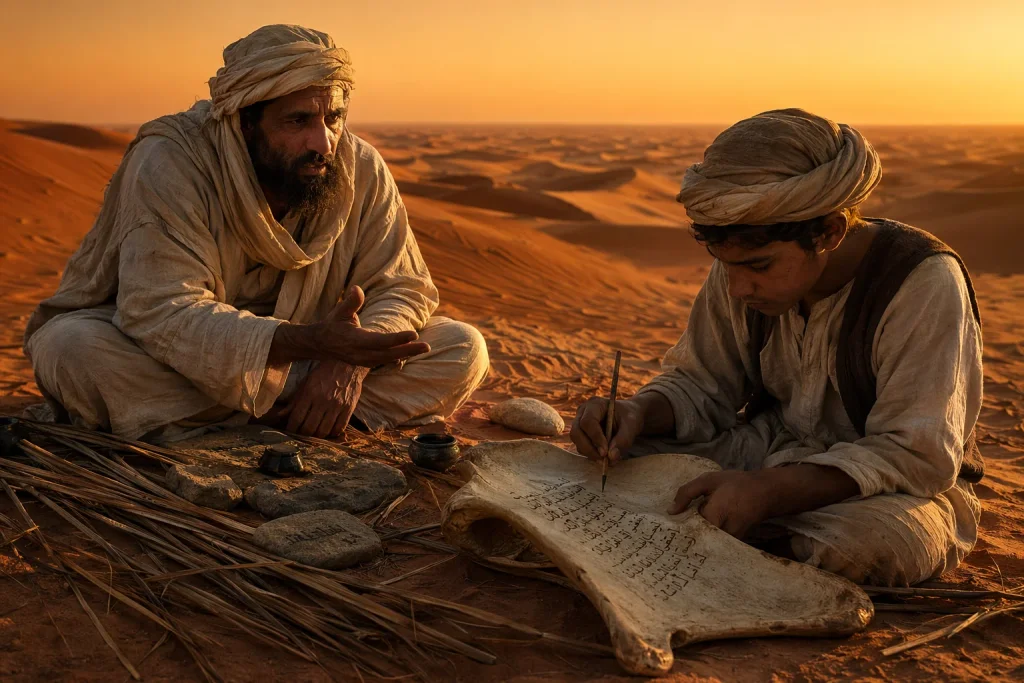
Muhammad dictates in the desert while a scribe writes on shoulder bones and palm leaves — he cannot verify a single word

Written on bones, bark, and leaves — he could never read back a single word.

Interactive Challenge

Can Human Memory Match the Claim?

One short passage. Twelve seconds. Then write it back word-for-word. This is how the Quran was transmitted — except it was 6,236 verses over twenty-three years.

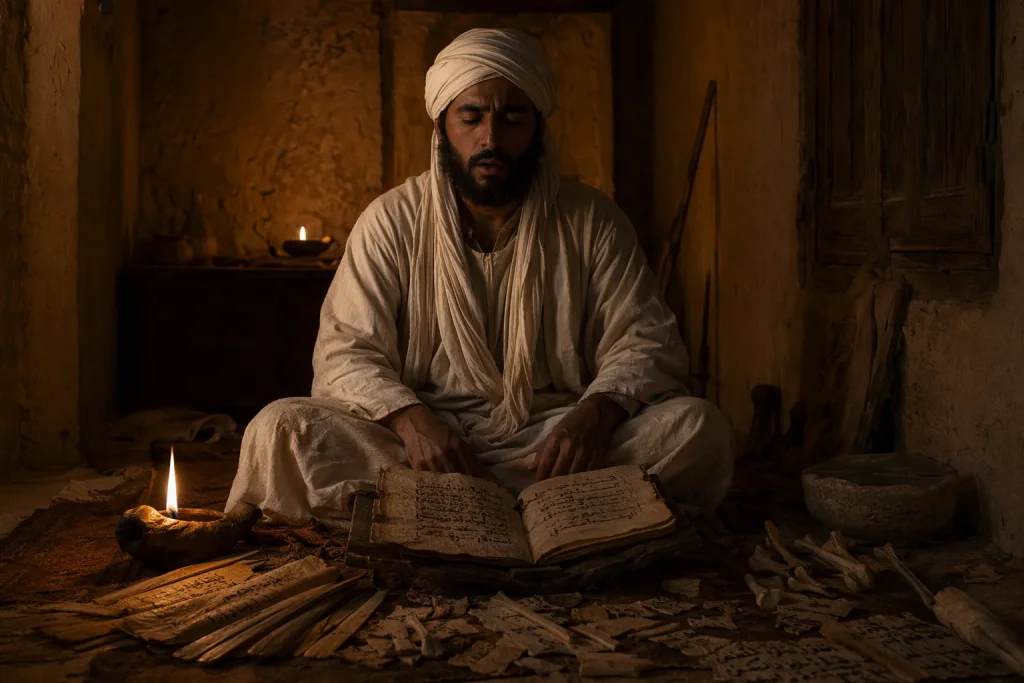
A 7th century Arab man concentrating deeply, trying to memorize sacred text by lamplight

"I used to recite a surah the length of Barā'ah — and now I cannot recall a single verse." — Abū Mūsā al-Ash'arīMuslim 1050

You will see a passage for twelve seconds. Then it vanishes. Write it back from memory — exactly as written. No paraphrasing. Each attempt gives you a different verse.

Thousands of manuscript pages falling into a dark abyss
The Mathematics of Memory

Why Flawless Transmission Is Impossible

Even if every memorizer in history had superhuman recall, mathematics proves perfect preservation is impossible. And a universal law of probability confirms it.

How to read this

The slider below sets how accurately each memorizer recalls each individual verse. Even at 99% — meaning only 1 error in every 100 verses — the chance that all 6,236 verses survive without a single slip is calculated by multiplying that accuracy 6,236 times. The result is the probability of a perfect Quran reaching us — and it collapses to near zero.

Reality check: 98% accuracy means getting only 2 words wrong in every 100. Over 23 years of oral recitation with no written master copy to check against, who maintains even that? Professional actors forget lines after weeks of rehearsal.

Recall accuracy per verse
98%
90%Beyond any human99.999%
Probability of zero errors across all 6,236 verses
10⁻⁵³%

⚠ BEYOND BOREL'S LAW — IMPOSSIBLE

Borel's Law of Large Numbers

Mathematician Émile Borel established that any event with a probability smaller than 1 in 10⁵⁰ (that's a 1 followed by 50 zeros) will never occur — not once in the entire history of the universe. This is not opinion; it is a mathematical law accepted across probability theory.

⚠ Current probability: ~10⁻⁵⁵ — this has crossed Borel's threshold. Perfect preservation at this accuracy is not merely unlikely. It is mathematically impossible.

99.4%errors
At least one error — 99.4%
Perfect preservation — 0.6000%

The red bar shows the chance of at least one error creeping in. At 98% accuracy — already far beyond what any human sustains over decades — perfect preservation of 6,236 verses crosses into the realm of mathematical impossibility. This is one memorizer, one generation. The real chain spans dozens of people across fourteen centuries.

The Perfect-Memory Defense

Even He Reached for a Pen

The last line of defense is a divinely perfect memory. The Islamic sources dismantle it themselves.

The Deathbed Request

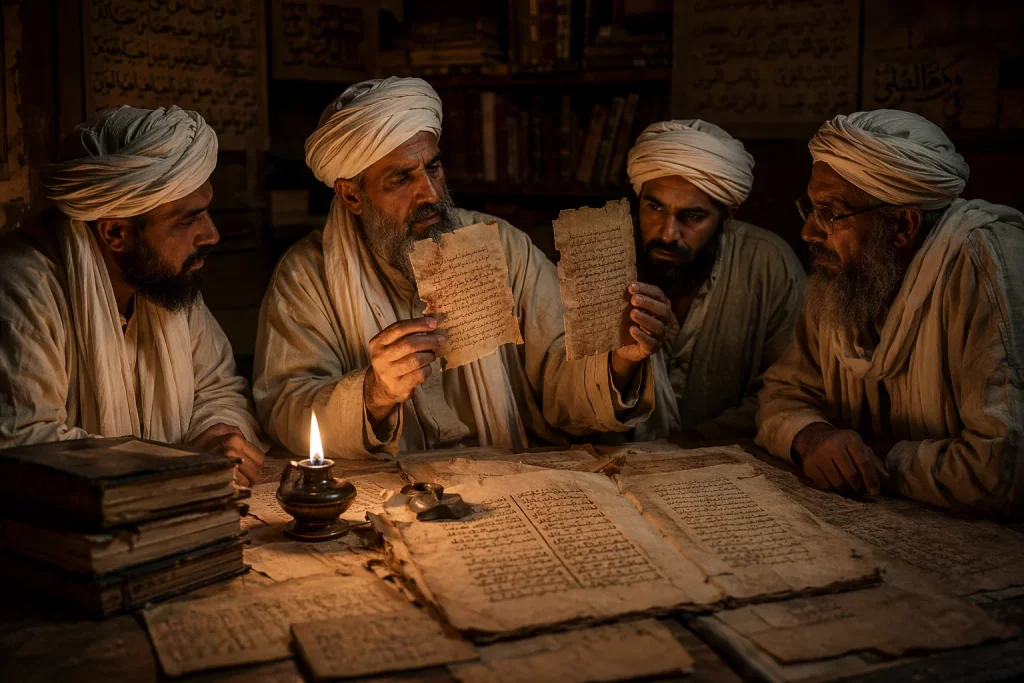
“Bring me writing materials so that I may write for you a statement after which you will not go astray.”

Sahih al-Bukhari 114

At the most critical moment of his life, the man whose flawless memory supposedly guaranteed the Quran reached for a pen and parchment — because memory and the spoken word were not enough. Ibn Abbas wept over this moment, calling it "the calamity of Thursday" — the day the companions argued and refused the Prophet's dying wish.
Read the full analysis
Companions arguing at the bedside of a dying man
The Logical Fork

The Islamic Dilemma

The Quran creates an inescapable logical contradiction about the Bible. Either horn of the dilemma is fatal to the Islamic position — there is no middle ground.

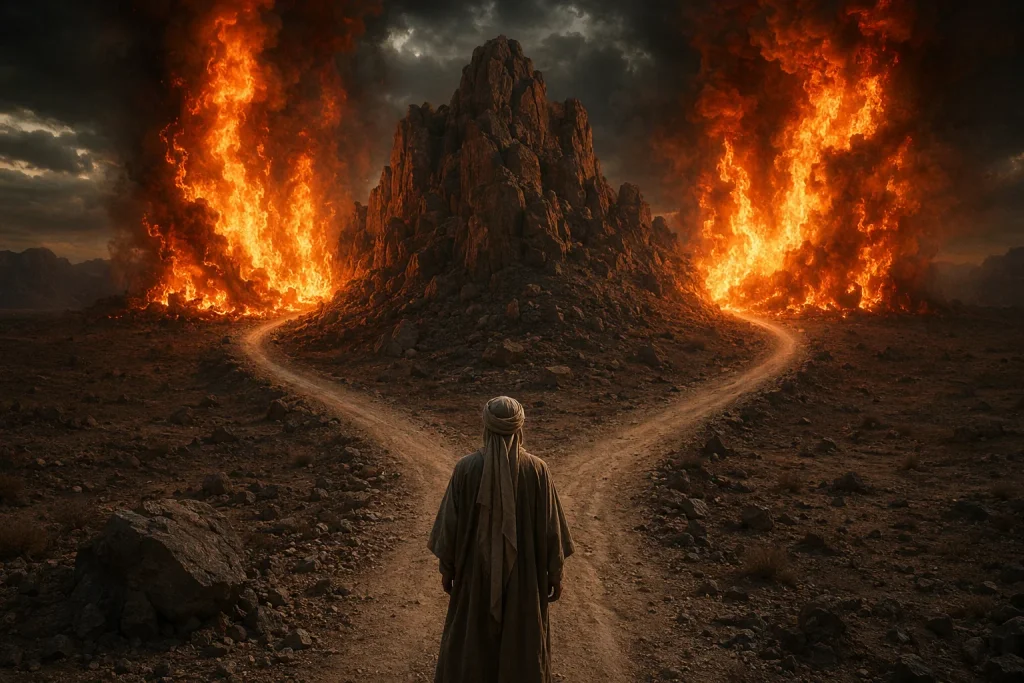
A man trapped at a fork in the road — both paths lead away from Islam
1

The Quran affirms the Torah and the Gospel

Surah 5:46–47 states that God gave Jesus the Injīl (Gospel) ‘in which was guidance and light,’ and commands Christians to ‘judge by what Allah has revealed therein.’ Surah 3:3 confirms God ‘sent down the Torah and the Gospel… as guidance for the people.’

Surah 5:46–47 · 3:3
2

The Quran declares God's words cannot be altered

Surah 6:115 proclaims: ‘None can change His words.’ Surah 18:27 repeats the same guarantee. If God's words are immutable, then the Torah and Gospel He sent down cannot have been corrupted after delivery.

Surah 6:115 · 18:27
3

Yet the Bible contradicts core Islamic doctrines

The Gospel teaches that Jesus died by crucifixion and rose bodily (1 Corinthians 15:3–4). The Quran explicitly denies this in Surah 4:157. The Torah records God's covenant through Isaac; the Quran redirects it to Ishmael. Both cannot be true.

Surah 4:157 vs. 1 Corinthians 15:3–4
AHorn One

The Bible was corrupted

Then God failed to guard His own revealed words — directly contradicting Surah 6:115 and 18:27. The Quran's own theology collapses from within.

BHorn Two

The Bible was not corrupted

Then the Gospel's testimony about Jesus' death and bodily resurrection stands — and the Quran's flat denial in Surah 4:157 is false.

Either the Quran is wrong about the Bible being preserved, or the Bible is right and the Quran is wrong about Jesus. Both roads lead away from Islam.

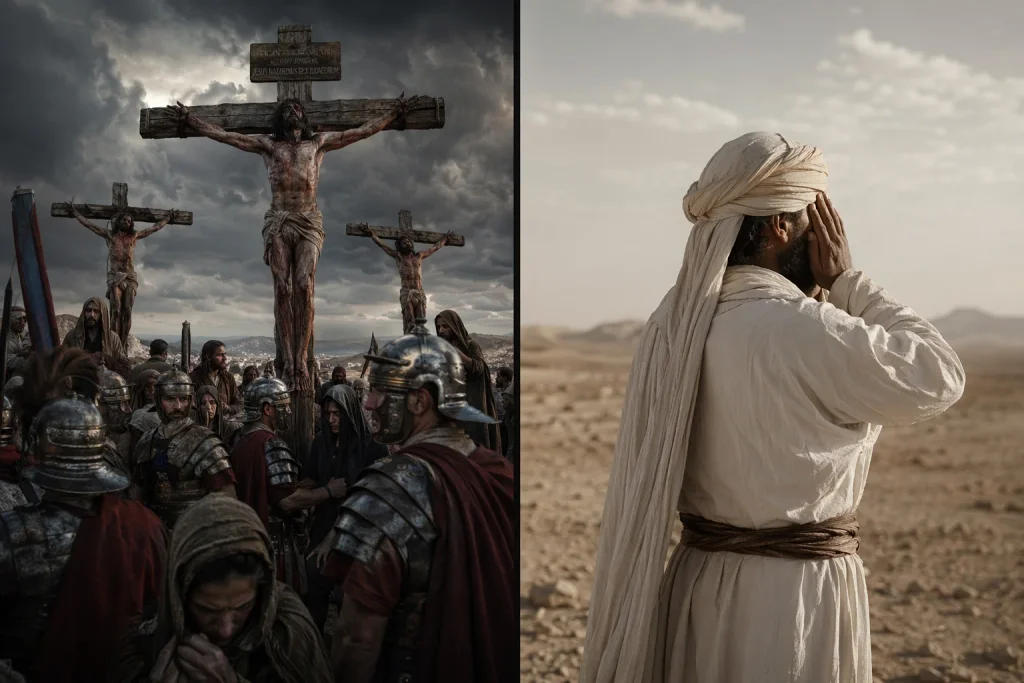
Split scene: Jesus on the cross with witnesses vs a lone man denying it 600 years later
From TheHistoryOfIslam.org

The Quran's Jesus vs. The Real Jesus of History

The Quran claims to confirm the Gospel. But on the most fundamental facts about Jesus, it contradicts everything the earliest witnesses recorded.

Death on the Cross

The Gospel says

Jesus was crucified, died, and was buried — attested by all four Gospels, Paul's letters, Josephus, and Tacitus (Matt 27; Mark 15; Luke 23; John 19).

The Quran says

‘They did not kill him, nor did they crucify him, but so it was made to appear to them.’

Why it matters: The most multiply-attested event in ancient history, denied by a single author writing six centuries later with no cited source.

Bodily Resurrection

The Gospel says

Jesus rose from the dead on the third day and appeared to over 500 witnesses (1 Corinthians 15:3–8; all four Gospels).

The Quran says

No resurrection is mentioned. Jesus was ‘raised to Allah’ without dying (4:158) — a spiritual assumption, not a bodily rising.

Why it matters: The foundation of Christianity — attested by named eyewitnesses within years of the event — is flatly denied without counter-evidence.

Divine Sonship

The Gospel says

Jesus is the eternal Word made flesh, the Son of God through whom all things were created (John 1:1–14; Colossians 1:15–20).

The Quran says

‘It is not befitting for Allah to take a son. Exalted is He!’

Why it matters: The Quran denies the central confession of the earliest Christian communities — a belief documented decades before the Quran existed.

Substitutionary Atonement

The Gospel says

Christ died for our sins according to the Scriptures (Romans 5:8; 1 John 2:2; Isaiah 53).

The Quran says

No concept of substitutionary sacrifice; ‘no bearer of burdens will bear the burden of another’.

Why it matters: The Gospel's central soteriological message — that God Himself bore the cost of human sin — is entirely absent from the Quran.

The Quran says it “confirms” the Gospel. But on every central claim about Jesus, it says the exact opposite. A book that contradicts what it claims to confirm has a credibility problem.

Explore more at TheHistoryOfIslam.org
A broken wax seal on an ancient document
Weighted Assessment

The Claim on Trial

How does the Quran's preservation claim hold up when measured against six evidence-based criteria? Methodology inspired by FaithScore.org.

19
19 / 6032%

Verdict: Claim Not Supported

Manuscript Evidence3/10

The earliest substantial manuscript (Ṣan'ā' palimpsest) reveals a variant lower text. No complete muṣḥaf from Muhammad's lifetime has ever been found.

Chain of Custody4/10

An 18–20 year gap separates Muhammad's death from 'Uthmān's standardisation. Rival codices were destroyed. A single private sheaf was held by Ḥafṣa for years with no public access.

Internal Consistency3/10

Multiple qirā'āt remain in print today with hundreds of consonantal and semantic differences. The seven aḥruf doctrine itself admits sanctioned variation.

Source Honesty5/10

Islamic sources themselves record lost verses, forgotten surahs, and the state-ordered burning. Muslim scholars openly acknowledge variant readings exist.

Verification Method2/10

An illiterate prophet could not verify his scribes. Memorisers died in battle. No independent cross-checking mechanism existed at any stage.

Hostile Attestation2/10

No contemporary non-Muslim source confirms the Quran's text during Muhammad's lifetime or the decades immediately following his death.

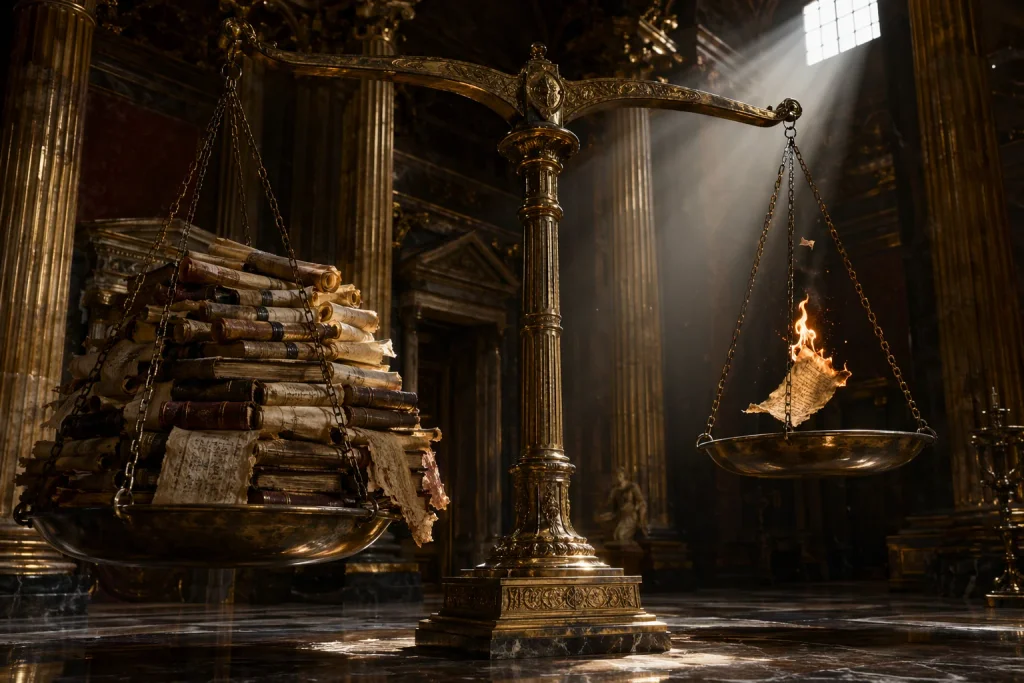
Balance scales weighing stacks of manuscripts against a single burning page
The Evidence Weighed

Quran vs Bible Preservation

A side-by-side comparison of the manuscript evidence, chain of custody, and preservation methods for both traditions.

Gap to standardised text
Bible: Multiple independent manuscript families preserved across different regions
Quran: 18–20 year gap before standardisation; all rival copies then burned by state order
Earlier versions retained?
Bible: Thousands of variant manuscripts survive and are studied openly by scholars
Quran: Companion codices destroyed by caliphal decree — no comparison possible
Documented lost material
Bible: Textual variants catalogued, compared, and published in critical editions
Quran: Stoning verse, suckling verse, and entire surahs acknowledged as lost
Earliest physical evidence
Bible: Dead Sea Scrolls (c. 250 BC); 2nd-century NT papyri (P52, P66, P75)
Quran: Ṣan'ā' palimpsest (c. 650–710 AD) reveals a variant lower text beneath the standard
Facts First

Common Questions & Objections Answered

"The goat story is just abrogation — the ruling still applies."

Response. Abrogation of wording still concedes that revealed Quranic text was permanently lost from the physical muṣḥaf. A book missing divinely revealed words — regardless of the theological explanation — cannot simultaneously be called 'perfectly preserved letter for letter.'

"The seven aḥruf allow legitimate flexibility."

Response. Sanctioning multiple wordings is, by definition, the opposite of a single, perfectly fixed text. Moreover, 'Uthmān deliberately reduced the readings to one dialect and burned all competing copies — an act of editorial selection and political enforcement, not organic preservation.

"Ḥuffāẓ (memorisers) guaranteed perfect transmission."

Response. The Islamic sources themselves record memorisers dying en masse at Yamāma, companions forgetting passages, and senior reciters disagreeing with one another — the very crises that made emergency written compilation necessary in the first place.

The Full Archive

Go Deeper - Evidence in Detail

Every claim above opens into a fully sourced long-form exhibit.

A grand doorway with golden light streaming through

The Door Is Open

You have examined the evidence — drawn entirely from Islam's own authenticated sources. The claim of perfect, letter-for-letter preservation does not survive scrutiny. But this is not the end of the road; it is the beginning of a new one.

If the Quran's foundational preservation claim fails, what about its other claims? If it affirms the Gospel yet contradicts it on every essential point, where does truth actually reside? These are questions worth pursuing — with honesty, courage, and an open heart.

“You will know the truth, and the truth will set you free.”

John 8:32